Sous Vide
Popularized in the U.S. by French Laundry chef Thomas Keller, this technique is my default cooking approach wherever appropriate.
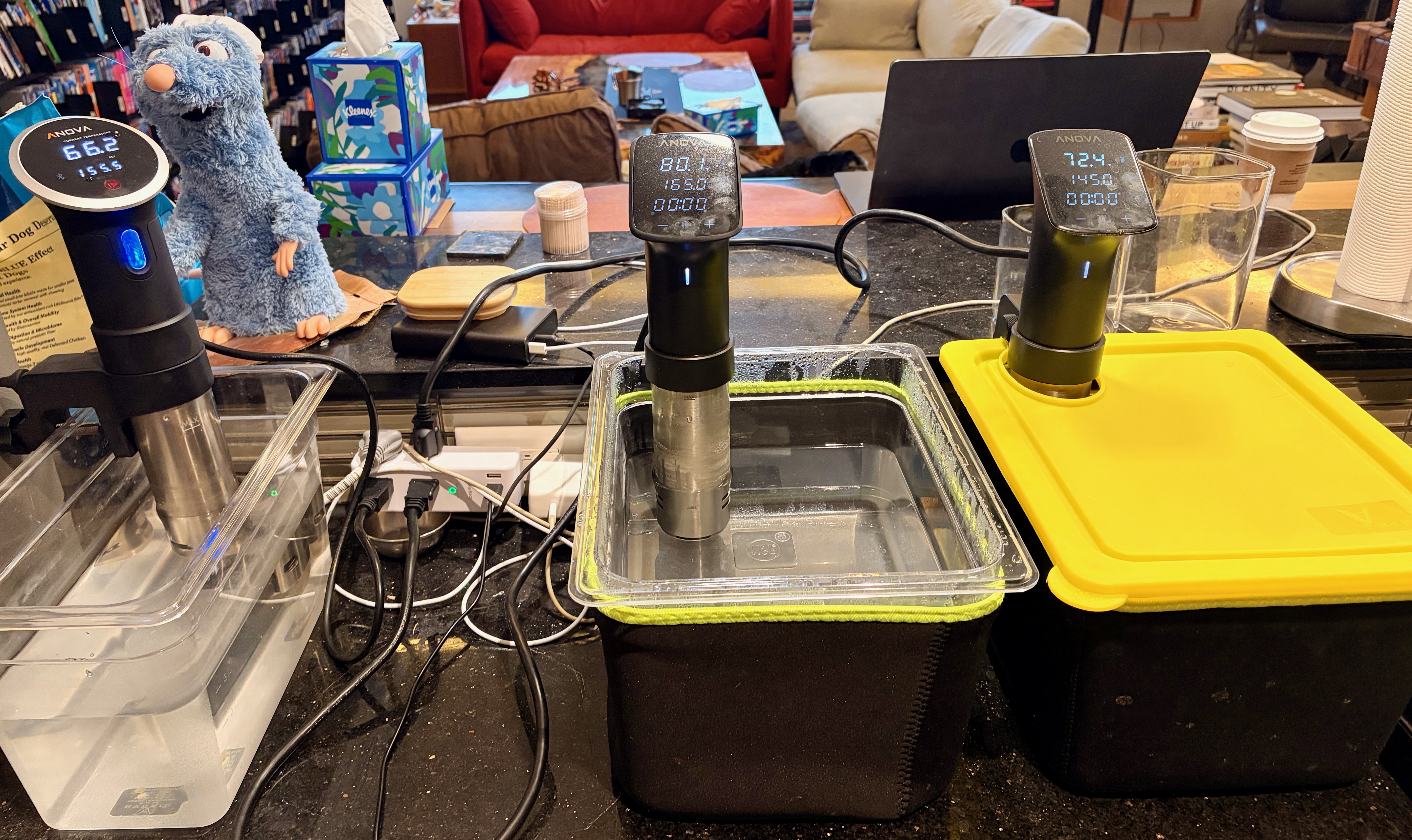
Sous vide (French for “under vacuum”) is a precision cooking technique in which food is sealed in a bag and cooked in a temperature-controlled water bath. Instead of relying on high heat and timing alone, sous vide uses exact temperature control to determine final doneness.
It is not primarily about the machine — it is about control.
It allows for long, slow cooks producing fall-off-the-bone results that are difficult to accomplish otherwise. An ex-girlfriend who hated beets actually "borrowed" a sous vide from me after experiencing the silky, intensely tender sous vide version. There is an egg yolk texture — thickened yet still fluid — that is nearly impossible to produce any other way.
The technique also integrates well with storing food. Vacuum seal an item and either cook and freeze it, or just pop it in the freezer and sous vide it when you pull it out, no need to thaw separately. Some people make all their meals on a Sunday, vacuum seal them, then do a quick warm up throughout the week.
Sous vide can also be used to thaw vacuum-sealed items quickly and safely. A controlled water bath brings food to refrigerator temperature far faster than air alone, making frozen ingredients available in minutes rather than hours.
What It Does
Sous vide separates two normally intertwined variables:
- Temperature determines doneness
- Time determines tenderness and structural change
In traditional cooking, these are often inseparable. In sous vide, they can be controlled independently.
This allows for:
- Exact doneness (e.g., medium-rare edge to edge)
- Gentle collagen conversion
- Controlled fat rendering
- Minimal moisture loss
- Repeatable results
Core Equipment
While sous vide is a technique, it requires specific tools:
- Immersion circulator – Heats and circulates water to a precise temperature.
- Container or water bath vessel
- Vacuum sealer or zip-top bags
- Optional: rack, weights, insulation
The immersion circulator is the enabling device. The technique is the principle of low, stable temperature cooking.
I suggest never buying a circulator that requires online or phone connection; a popular brand I was using simply stopped working when the company was purchased. I now use Anova machines, which have but don't require an online component; you can simply plug them in, use the physical interface to specify time and temperature, and start cooking. In my experience, app integration adds little practical value to kitchen devices.
Typical Temperature Ranges
General guidance:
- 120–130°F (49–54°C): Rare to medium-rare red meats
- 130–140°F (54–60°C): Medium red meats
- 140–150°F (60–66°C): Poultry, firmer meats
- 150–165°F (66–74°C): Collagen conversion zone
- 170°F+ (77°C+): Fall-apart textures, braise-like results
Exact times and temperatures vary by cut and desired texture.
Advantages
- Precise doneness control
- Ability to tenderize tough cuts without overcooking
- Make-ahead convenience
- Minimal active cooking time
- Consistency
Limitations
- No browning occurs in the bag
- Meats often require separate finishing (searing, broiling, glazing)
- Longer cook times
- Equipment investment, though a single sous vide stick is very affordable
Sous vide is often best understood as a structural pre-cook, followed by high-heat finishing.
Related
- Sous Vide
- St. Louis Spare Ribs
- Cauliflower Velouté Sauce